

The dog whistle you can’t hear. The rumbling thunder that you can. The rock concert that leaves your ears ringing for days. All of them are examples of sound energy.
On a deeper level, sound energy surrounds us, whether our human ear can pick it up or not.
Sound can be as melodic and pleasant as a blackbird’s song to as visceral and physical as the roar of a jet engine. But do sounds always sound the same? Join us as we explore sound energy and how it shapes our relationship with the world.
What Is the Definition of Sound Energy in Science?
Sound energy is one of many different types of energy in the world, some of which include nuclear energy, light energy, mechanical energy, and electrical energy.
Sound energy is actually a form of mechanical energy. In its simplest form, sound energy is vibrations moving through something. Sound travels through solids, gases, and liquids as energy waves.
More precisely, sound travels as sound waves. These sound waves are vibrating particles. So, what’s the definition of sound energy? It’s the energy that is released when an object vibrates. And why do objects vibrate? Because a force, such as pressure or sound, makes them vibrate.
What Are Examples of Sound Energy?
Sounds are all around us. Sit quietly for five minutes and identify as many sounds as you can. These could include:
- The low rumble of traffic outside
- The gentle buzz of air conditioning or ceiling fan
- Children playing and shouting outside in a park
- Dripping water or the pitter-patter of rain on a roof or window
- Dogs barking
- The hubbub of people chating
- A television blaring in another room
- Leaves rustling in the trees
Or as French composer Pierre Schaeffer poetically stated: “Sound is the vocabulary of nature.”
How Do We Hear Sound Energy?
Sound sources and their effect on the human ear range from our active enjoyment of them to adverse reactions. A sound’s loudness, pitch, and intensity can provoke everything from joy to ear-covering misery. There’s a reason most people don’t want to live next to a busy road or train line.
Sound waves from noises travel to our ear canals and into our eardrums. These vibrations make our ossicles, which are three tiny bones, vibrate.
Remember how sound is vibrations moving through something? The sound wave vibrations journey continues.
After the ossicles, sound waves travel to our cochlea, a hollow, spiral-shaped, snail shell-type tube. The cochlea’s hair cells convert the vibrations of the air molecules within the sound waves into something our brains can hear. This is the process of achieving what we know and understand as sound, or noise.
Enter your ZIP Code and compare electricity rates
Different hair cells “hear” different sounds depending on their location within the cochlea. That’s how the brain understands the difference between high- or low-pitched sounds.
The study of sound is called acoustics in the world of physics.
Sound Energy Definition: The Science Explained

We know sound energy is a type of mechanical energy. It produces a mechanical wave, so we recognize sound energy as a wave. We can also classify sound into one of the two primary forms of energy.
Sound energy can be:
- Stored as potential energy
- Moving as kinetic energy
Beat a drum head, and sound waves, or sound energy, vibrates the air molecules that surround the drum. Those sound waves travel through the air, and that movement makes sound energy kinetic in this form. A thunderous drum’s sound waves may pass through nearby walls and floors, showing how sound waves can travel through solids as well as the air. Sound energy is kinetic as it travels in this waveform.
When an object vibrates and moves sound waves, we call this propagation. In this context, propagate means to transmit sound through a medium like air, gas, or liquid.
What Are Sound Waves and How Do They Work?
Sound waves are sometimes called mechanical waves. That’s because—to propagate—sound waves require a liquid, solid, or gas material to transmit, or transfer, sound pressure variations.
Sound waves, like all waves, have peaks and troughs called oscillations. The peaks are called compressions, and the troughs are known as rarefaction.
To picture a sound wave, think about a Slinky toy. Move the Slinky up and down from one end, and a continuous wave travels along the Slinky. This is called a transverse wave. Sound energy, or the waves from a vibrating object, travel outwards from an object the same way.
A sound wave produces energy as it moves through a liquid, solid, or gas. That energy comes from the wave moving from its peak to its trough position. These waves have a frequency.
Frequency range is a term commonly used with sound and noise, also known as pitch. It is measured by how often a sound wave repeats itself every second. Low frequencies have fewer oscillations than higher-frequency sounds. For example, a drum has a low frequency with very few oscillations. A chirping cricket produces sound waves with a higher frequency.
Sounds too high for the human ear are called ultrasonic, while those too low are called infrasonic.
Now let’s consider how those waves travel through different mediums, like air, gas, or liquid. Each element affects the sound waves in different ways.
Listen to a song in a room. It should be clear as the sound waves travel through the air. Next, close all the doors and windows in the room with the stereo still playing and listen to the song in a different room. The sound you hear differs as the waves travel through the solid walls. Finally, run a bath and listen to the music with your head underwater. Sound waves travel faster underwater, changing the sound once more.
How Does Loudness Affect Sound Energy?
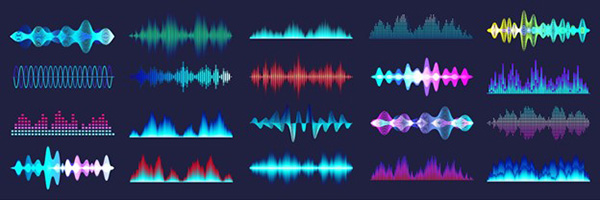
We know a sound’s frequency, or pitch, changes depending on the number of wave oscillations per second. Sound waves also change depending on the sound’s loudness.
Loudness will increase the peaks and troughs of a sound wave. The louder the noise, the higher the sound wave’s oscillation and the greater amount of energy that sound wave contains. The height of a wave is known as the sound wave’s amplitude.
Quiet noises created on ASMR videos will have little amplitude. An explosion has a high amplitude and, therefore, more energy than ASMR recordings. You can see this concept on WhatsApp voice notes. These notes have a basic sound waveform amplitude to show the speaker’s voice volume.
Let’s think about the musical instruments in an orchestra. Most people could probably handle standing next to a triangle player, whose instrument has a high pitch but a relatively low amplitude.
What about being next to a kettledrum player? On every drumhead strike, you’ll feel those low-frequency sound vibrations rumbling through your body at close range. The noise may be loud, and you’ll feel the sound wave vibrations.
Most people would cover their ears if they stood next to the high amplitude and pitch of the trumpet section. The high frequency coupled with loudness would make this an unpleasant experience for most.
We can see how loudness and frequency affect the human ear. Exposure to excessive noise can even make us deaf, which is why airport workers wear ear defenders. Constant exposure to the high sound intensity of jet engines damages people’s hearing.
How Do We Measure Sound Energy?
Scientists can determine an object’s loudness by measuring its sound energy density level, or sound pressure, measured in decibels.
The average human’s hearing ranges from 0 decibels (dB) to 120-130 dB. Here are some sound intensity examples:
- Breathing: 10 db
- Ticking watch: 20 db
- Refrigerator: 40 db
- Air conditioning: 60 db
- Gas-powered leaf blowers or lawnmowers: 80-85 db
- Approaching subway train: 100 db
- Standing by sirens: 120 db
- Firecrackers: 140 db
- Aircraft taking off (outside the plane): 140 db
Anything over 120 decibels can cause ear injury and pain.
How Good Is a Human’s Hearing?
Humans can withstand noises up to about 120 decibels. But what can we hear? Pitch, or frequency ranges, are measured in Hertz (Hz) and Kilohertz (kHz).
As a species, we humans can detect sound waves with a frequency range of 64 Hz up to 23,000 Hz. Most daily conversations and hearing occur between 20 to 8,000 HZ.
Dripping water has a relatively low hertz rating, alongside other noises like waves, thunder, and an elephant trumpeting. Higher frequencies for humans start at around 2,000 HZ and include noises like mosquitoes, whistles, and squeaks.
Aging adults lose some of their listening frequency, meaning children can hear higher-frequency noises that older people can’t. Try this high-pitched hearing test to see how well you can hear different frequencies.
Animals have different hearing ranges than humans, with larger animals having lower ranges than smaller mammals in general.
For example, an elephant’s range of 16 Hz to 12,000 Hz means many of the low-pitched noises they make are simply out of our hearing range. A dog’s range is 67-45,000 Hz. They can hear higher-pitched noises we can’t. A bat may reach up to 110,00 Hz. An outlier is the beluga whale, which is an enormous animal, yet hears up to 123,000 Hz.
Can Sound Energy Be Converted to Electrical Energy?

Yes, sound energy can be converted into electric energy. A microphone works by someone speaking or singing into it. Sound energy travels through the mic and makes its diaphragm vibrate. In turn, this moves a magnet near a coil, producing an electrical signal.
A loudspeaker receives and then turns this electrical signal back into sound waves, coming out as the amplified sound we hear.
Is Sound Energy Renewable Energy?
Sound energy is renewable energy, but not in the way we think about solar energy or wind energy. Sound is everywhere and can be converted into electrical energy and replenished.
However, the technology remains theoretical. A train screeching past you creates little electrical energy. Small-scale possibilities that capture the vibrations created in subway stations or concerts may be developed one day. In reality, natural gas power plants need not worry that sound energy plants will replace them soon.
What Is the Speed of Sound?
The speed of sound changes depending on where you are. Air temperature, the sound wave frequency, and the material the wave passes through all affect the speed of sound.
For practical purposes, on Earth, at sea level, with an air temperature of 59 degrees Fahrenheit (15 degrees Celsius), the speed of sound is 761.2 mph (1,225 km/h). Temperature is critical because sound travels faster through warmer air. So, if you were to fly an aircraft higher in the atmosphere, where the air is cooler, the speed of sound is lower.
Aircraft that break the speed of sound create a sonic boom. Air gets pushed aside at great force when this happens, creating a shock wave that produces a thunder-like sound.
How Is Sound Energy Used?
We use sound energy daily. Examples of sound energy include alerts to messages or calls on our cell phones, talking, and entertaining ourselves with music.
Doctors use ultrasound to scan organs, break up kidney stones, or help monitor expectant moms’ babies. Ultrasound uses sound energy vibrations at a frequency too high for us to hear. Ships use sound energy in their sonar systems for navigation and mapping.
Can Sound Energy Be Stored?
In theory, sound energy can be stored. Mechanical waves, of which sound waves are a type, change form once they interact with another object. Some scatter and some are absorbed by the object.
Any absorbed sound waves become another form of energy. Scientists have found a way to store this absorbed sound energy. It can then be turned into electrical energy when required. This process is called coherent virtual absorption. For now, the tech is in its infancy. Still, a breakthrough may see sound energy become a component in the race to use more renewable energy sources.
Can You Hear Sound in Space?
It was in 1979 that the famous sci-fi film “Alien” brought us the phrase, “In space, no one can hear you scream.” What’s more, it’s true.
Space is a vacuum. There are no air molecules in space’s vacuum. That means sound waves cannot vibrate or travel through the void of space. Pretty wild, right?
Who Discovered Sound Energy?
Acoustics fascinated some of the greatest minds in history. Greek philosopher Pythagoras experimented with vibrating strings in the 6th century BC, while Aristotle devised theories about sound wave propagation.
Galileo studied acoustics in the 16th and 17th centuries. Next, French mathematician Marin Mersenne wrote three of the founding laws of acoustics. The English physicist Robert Hooke produced the first sound wave with a predetermined and known frequency.
French physicist Joseph Sauveur devised much of the modern understanding of sound energy. His work, in the late 17th and early 18th centuries, studied how waves, pitch, and frequencies were linked.
Sound Energy: Much More Than Noise
Sound energy can travel through air, gases, and liquids thanks to its waveform. It can be loud or quiet, high- or low-pitched, and is often out of a human’s hearing range.
How we hear things depends on how the sound waves reach our human ears and through which materials they have passed. Indeed, ultrasound is just one of the ways we use sound energy we can’t hear.
A whisper can be lost underwater or sound loud next to your ear. The thunderclap from lightning that causes a power outage can be house-shakingly frightening or more like a rumbling mythical cloud beast, depending on your proximity to the storm.
We cannot hear every sound out there. What we do know is that even if we don’t hear something, like a tree falling in a forest, it produces sound waves. Sound energy very much depends on who and where you are as to what you hear.
And you know what that means? Theoretically, even the worst shower singer could sound good under the right conditions!
Brought to you by energysavings.com
All images licensed from Adobe Stock.